

Paola De Martin
Swiss Grand Prix Design 24 Paola de Martin
Avanti guanti – the new avant-garde is ready for action!
by Francesca Petrarca
I first encountered Paola in a photo before I knew where she stands. I read her blogs before I knew how she speaks. When I heard her voice on the radio, I was struck by what she has to say.[1] Paola De Martin is a mover. She moves herself, me, and others too. She is a scholar-activist whose career has
followed a unique pattern. Her work makes connections. It is activist design research into the unspoken interplay between aesthetics, society, and class. Bidding farewell to silence, she has spoken out in various publications. She excels in peaceful protest, confronting the charged social contexts of the present with symbolic disarmament – always inquisitive, never alone.
There is always this mesh that holds everything together. Encompassing literature, art, and design, her way of working creates links to history and sociology, and is always turned towards others. It is an intertwining metamorphosis that produces objects, performances, lectures, letters, photos, music, radio plays, essays, and articles. In her role as an educator at design schools and as a postdoctoral lecturer at ETH Zurich, Paola is very popular among students. She invites them to reflect on exclusion and encourages them to examine their own social background and privileges from an intersectional perspective. Her thoughtful lectures make an impact, guiding listeners towards new ways of engaging with norms, rules, and structures. She adopts critical standpoints and inspires a new generation of designers. Oral expression fertilises written reflection and vice versa. Her work with the Schwarzenbach-Komplex collective took her from the “loneliness of the long-distance runner” to a close-knit community of like-minded friends. The association she founded, TESORO, has ignited public interest in reassessing Swiss family policy. Paola works her magic on multiple social threads, weaving them into an entirely new fabric.
If the private is political, as the early feminists said, then Paola’s central question is this: just how political is aesthetics? Paola has gifted me some gloves she knitted herself, featuring a complicated pattern in green and pink. Knitting helps her to organise her thoughts and find inner strength when the outside world is cold and cynical. Constructive resistance is deeply rooted in her. Paola recalls her time at primary school in the Affoltern district of Zurich, where her handicraft teacher told her not to knit “the Italian way” because it was not like the way she taught, and she would not be able to help the young Paola if she made an “Italian mistake”. Luckily, Paola was able to combine the two techniques (secretly at first), eventually making the act of combining her leitmotif.
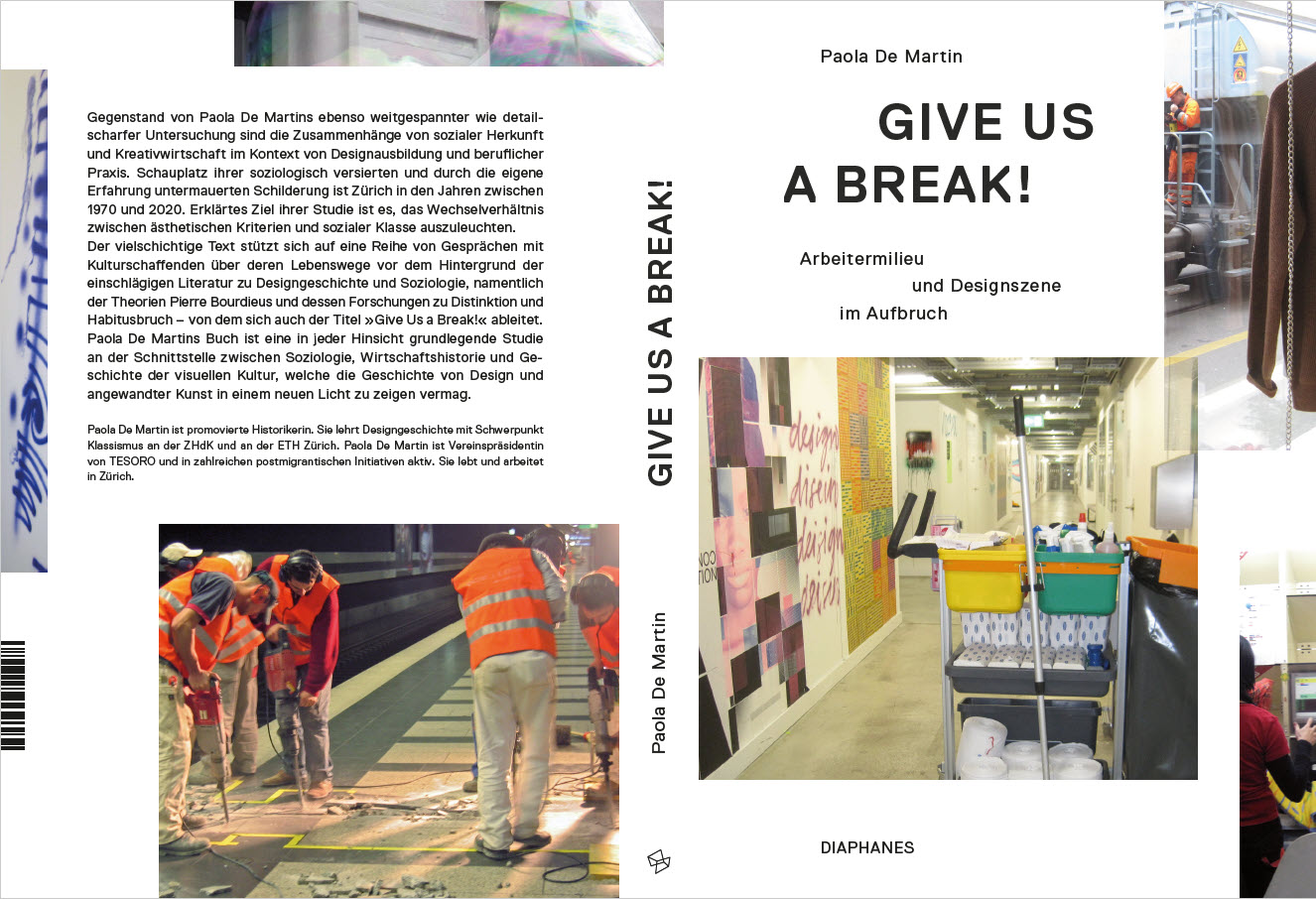
In her dissertation Give us a break! Arbeitermilieu und Designszene im Aufbruch (Diaphanes, 2020), Paola’s voice unleashes into a distinctive expression that articulates a tapestry of previously untold stories. It deals with feelings of belonging and exclusion on the Zurich design scene that was her workplace in the 1990s as a textile student, and later as co-founder of the fashion label Beige. The starting point is her social background, having experienced limited access to the education system as the child of a migrant working-class family. She ultimately pinpoints the historical inequities in design that had previously caused her a lack of orientation, by carefully examining the unsaid; the elephant in the room ignored by the “inheritors of cultural capital”. Unafraid to take risks, Paola exposes herself as a researcher, taking on a reflective approach to her own entanglements, biases, and indeed privileges. She draws on both theory and autobiographical literature to craft a dense web of relations. Her work sheds light on the system within which designers operate. It is a manifest criticism of the established structures that reflexively exclude people with underprivileged backgrounds from the field, pigeonholing them and passing them up by favouring others.
[1] Mali Lazell, Julia Haenni: I want it all! Strike portraits, edition clandestin 2021, no pagination; Brennende Unschärfe – Offener Brief an Bundesrätin Simonetta Sommaruga, Institut Neue Schweiz INES, blog, 21 September 2018; Per arrivare bisogna partire, Institut Neue Schweiz INES, blog, 4 November 2019; Saisonnierstatut: Das war ein Attentat auf die Familien (SRF 2 Kultur, Kontext, 7 December 2021).
The lines of her manifesto are like the colourful yarns from which my gloves were made. There is protest in carrying on with her knitting, even after the teacher told her to stop and “do it properly”. There is protest in her parents bringing her back into Switzerland as a small child, even after the immigration authorities had her deported. There is protest in deciding not to keep quiet anymore. The fist that slowly opens in the fight for justice: it unpicks the flaws in its own fabric and refashions itself into a strong and peerless glove. Our memories go hand in hand. My own nonna once showed me the intricate gloves she had crocheted herself, elegant guanti that she would don to go out on a stroll in Italy and later Switzerland. Unfortunately, they have gone missing. This loss weighs more heavily than one might think. It echoes in the inherited feeling of my nonna’s loss, who was not allowed to live in Switzerland with her own child, my mother. Paola’s gloves are starting to heal the wound. The rows of yarn enveloping my hands become an enchanting refrain, a magical rhythm unleashing an energy that flows onwards like a river.
It is hardly a coincidence that a designer with the “advantage” of a migrant background, as she ironically says, should ask the question: just how political is aesthetics? Paola opens up an uncharted space for reflection and invites us to think about classism and other forms of discrimination in our culture. She makes a bold transition from “I” to “we” when she states emphatically, “We cannot help which class we are born into, but we can understand and communicate the aesthetic judgements and reflexes to which this quirk of fate gives rise and – if we so choose – even change them.” Avanti guanti – the new avant-garde is ready for action!
Francesca Petrarca studied art history, media science, visual communication and iconic research in Basel and works as a freelance book designer. The second edition of her book No grazie, non fumo, a literary and visual account of her grandmother’s migration story, is to be published by edition clandestine in 2024.